
Beyond the turkey and jollof rice, a reflection on the sacrifices, triumphs and unspoken costs of pursuing the American dream.
The turkey comes out of the oven at 3:47 p.m., golden and glistening, and for a moment the whole house goes quiet.
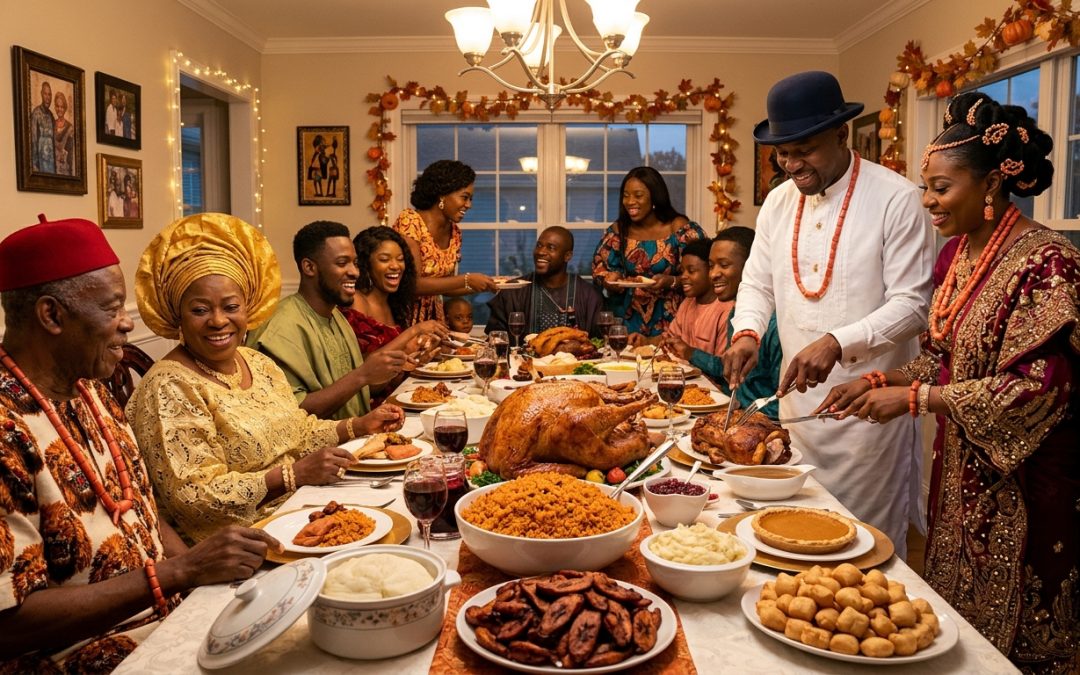
It is Thanksgiving in a Houston suburb, and Adaeze Okonkwo-Bell, 58, is doing what she has done for nearly three decades: standing over a table that holds two cultures at once. A brined turkey rests beside a steaming pot of party jollof. Green bean casserole shares space with peppered goat meat and fried plantain. Her niece's pumpkin pie sits next to a tray of puff-puff, still warm.
"People think it's a mix," Adaeze says, smoothing her wrapper. "It isn't a mix. It's a negotiation."
That negotiation, between what was and what is, is the real centerpiece of Thanksgiving for millions of Nigerian Americans. Nigerians are among the most educated immigrant groups in the United States, and many arrived with degrees, ambition and a suitcase packed with more hope than certainty. Behind the holiday's abundance sits a quieter question that rarely gets asked over dinner: *Was it worth it?*
The Price of the Ticket
Adaeze arrived in 1996 with $212, a nursing school acceptance letter and a promise to herself that she would be back in five years. She worked double shifts as a nursing assistant while studying at night. She remembers calling home on a calling card, rationing the minutes, listening to her mother's voice crackle across the Atlantic.
"My mother would say, 'Are you eating?' and I would say yes, even when I was having tea and bread for dinner," she recalls. "You don't tell them. You say, 'America is wonderful.'"
That silence, that polished version of the truth, is a thread running through nearly every immigrant story. Dr. Chidi Nwosu, 63, a Chicago engineer who left Enugu in 1991, remembers being overqualified and underemployed, a man with a master's degree stocking shelves overnight. "In Nigeria, I was Engineer Nwosu. People greeted me with respect. Here, I was a stranger with an accent," he says. "You swallow your pride because your children are watching, even before they are born."
The sacrifices were not only financial. They were missed weddings, funerals watched through grainy video calls, and the slow drift of childhood friendships. Many in the immigrant generation lost parents without being able to say goodbye. They bought plane tickets too late, or never at all.
The Gift They Gave, the Gift Taken for Granted
Around the table, the second generation arrives in sneakers and sweatshirts, scrolling through phones, fluent in Nigerian slang when it suits them and fully American when it doesn't. They are doctors, software engineers, lawyers and artists, living proof of the bet their parents placed.
They are also, sometimes, unaware of what that bet cost.
"I'll be honest, I didn't understand until I was an adult," says Tobi Adeyemi, 29, a Los Angeles marketing manager whose parents emigrated from Lagos. "I complained about being made to study on weekends. Then I found out my dad worked three jobs to pay for the school I was complaining about. I cried in my car."
Many of the children raised in this world carry a complicated double inheritance: tremendous opportunity, and the unspoken pressure to justify it. They have access to networks, safety and choices their parents never had. They also grapple with questions of belonging, too Nigerian for some spaces, too American for others.
"My parents gave me a life they had to give up everything for," Tobi says. "Gratitude feels too small a word for that."
The Empty Chairs
At Adaeze's table, there is a custom. Before the meal, she sets one extra plate and leaves it untouched. It is for the people who cannot be there: her late father, her brother in Port Harcourt, the cousins who still ask, in every phone call, when she is finally coming home.
"Thanksgiving is when it hurts most," she says quietly. "Because everyone is gathered, and you notice who is missing."
Across the diaspora, the holiday carries this ache. Family WhatsApp groups buzz through the day, voice notes arriving from Lagos and Abuja and Owerri, where it is already evening. Relatives ask what's on the menu. Photos are exchanged. Someone always jokes that they are sending their portion by air.
The distance is measured in more than miles. It is measured in birthdays missed, in children who know their grandparents only as faces on a screen, in the guilt of living comfortably while loved ones navigate fuel queues, inflation and uncertainty.
Did the Dream Deliver?
Ask Nigerian immigrants whether the American dream lived up to its promise, and the answers are rarely simple.
Many point to real triumphs: homes owned, businesses built, children graduated, debts cleared and remittances sent home. Others speak of ceilings that were higher than expected, of racism that arrived without warning, of an economy where hard work does not always guarantee reward.
"The dream is real, but it is not free," Dr. Nwosu says. "Nobody puts that part in the brochure."
Some have found the dream fulfilled. Others are still waiting. A growing number have begun splitting their lives between continents, building homes in Nigeria and returning during the holidays, trying to live in both worlds at once.
Learning to Love the Journey
As the sun sets, Adaeze's family joins hands for grace. Her eldest son leads the prayer in English; her mother-in-law adds a blessing in Igbo. Voices overlap. Nobody minds.
"I stopped asking whether I made the right choice," Adaeze says, watching her grandchildren fight over the last piece of plantain. "I started asking what I could do with the choice I made."
It is perhaps the truest Thanksgiving lesson: that gratitude and grief are not opposites. They sit side by side, like jollof and turkey, each making the other richer.
The destination may still be uncertain. But around that crowded table, loud with laughter and layered with memory, the journey, with all its losses and its gifts, looks a lot like home.
---
**Join the conversation:** *Knowing what you know today, would you make the same decision to leave Nigeria? Share your story with us.*